
Dispatches •
Dispatches #3: Building the policy plane as we fly it
Hi all,
Happy Wednesday. It’s another issue of Dispatches, this week focused on how our lab is following policy as we’re writing it. (Including this newsletter, which is the result of a newsletter policy-in-progress: not completely yet ratified, but still respected enough as a proposal that we’re already on issue number #3.)
If you’re new here, Dispatches comes every week from our Newspeak House governance laboratory: a group of 14 fellowship candidates exploring and experimenting with political technology, based out of our commons just off Brick Lane. You’re welcome to come visit us for our weekly Ration Club dinner on Wednesday nights and tell your friends to subscribe to our newsletter.
Read on for more, and if you have any feedback, responses, or ideas about what you’d like to see in Dispatches next, reach out to us at newspeakhouse26@gmail.com.
What policy in progress looks like
Since ratifying our constitution a month ago, we've been working together behind the scenes on many important policies: Dispatches, financial policies, safety and wellbeing, guest policies, etc. Most of them are coming out of commitments in the charter and those we made as a cohort at the constitutional convention, around values we wanted to hold onto: transparency, safeguarding, inclusion, and respect. Some of this is already in our constitution. The policies go further, spelling out how those values work in practice, for us and for anyone who interacts with the Lab in our day-to-day work.
How we're making policy
Policy-making is starting somewhere familiar: good old Google Docs, with plenty of suggestions and comments. Once the drafts were in good shape, both policies moved to GitHub, where we formally deliberate and vote.
Under our constitution, one Lab member has to submit a policy and at least one other has to endorse it. We use the native Github Reviewer approvals workflow, but are still getting it into practice!
Once a policy is submitted, a seven-day deliberation window opens for comments and voting. At the end, the final version lives in the Record for anyone to read. (Read more in our previous issue on recordkeeping if you’re interested.)
Each policy is being stewarded by its own organic drafting team. For example, Tess and Fernanda developed the Safety and Wellbeing Policy proposal, with input from several other members. Disha, Fernanda, and Mario did most of the work on the Financial Policy, since they were keen to explore Open Collective and a fiscal host arrangement for managing the Lab's money. And Madison and Anchit stewarded the Dispatches policy proposal.
All policies are now in their seven-day deliberation and voting phase. We'll share more once they're live!
Policy being practiced before protected
Sometimes, policy is observed and (partially) followed before it’s even officially ratified. Aside from the Dispatches newsletter, take our financial policy, for example.Right after the constitutional convention, we knew we'd be covering groceries every Wednesday for Ration Club. After cooking for the Fellows' Dinner and the first few Ration Clubs, we added a £70 spending cap per dinner to the draft policy. (For reference, that first veggie biryani fed nearly 50 people for £31.68.)
Because the policy is still in deliberation, the Treasury has encouraged the cap but not enforced it. In the past month, we've gone over £70 twice.
Beyond Ration Club, we needed a way to pay our recurring hosting fees for Dispatches and the cohort website. For now, those payments run through Disha's personal bank account as an interim solution.
The draft policy also sets a £50 monthly cap for everyday items that Lab members and visiting faculty need, like stationery. So far we've spent £5.23 of that pot, all of it on lamination pouches.
A note from Disha, our interim treasurer (read more on this role in our constitution).
As Treasurer, I wanted a financial policy that lets us explore new systems and ways of working while making sure we don't spend money on unnecessary recurring costs. I spoke to previous fellowship candidates to understand the financial instruments they used, their average weekly income and spending, and where there was room to experiment.
Fernanda and Mario's experience, contacts, and understanding of Open Collective and fiscal hosting have been really useful as we start setting up a transparent, open, collective payment platform. More on this in upcoming Dispatches!
What could the Lab's money do?
There's been no shortage of ideas. Lab members have floated using Lab funds to invite guest speakers, buy an air conditioner for the summer, curate our own LLM, and create a more physical artifact for the space.
“We have also been thinking of collectively organising ticketed events to raise funds beyond the donations we receive on an ad hoc basis, and of building on the ongoing Ration Club,” Disha said.
If you have ideas for how a governance laboratory should spend (or raise) its money, we'd love to hear them at newspeakhouse26@gmail.com.
Fellow updates
Joel
I am working on an open database of policy questions on AI and biosecurity and a way to tell which forecasts change decisions. If you work on forecasting or on decision tools in government, please email me at jonachro@gmail.com.
I run the Compute Governance Career Accelerator, a free eight-week online course for early-career people who want to help write the rules for AI chips, data centres and electricity. A second cohort starts in early 2027: https://computefellows.org
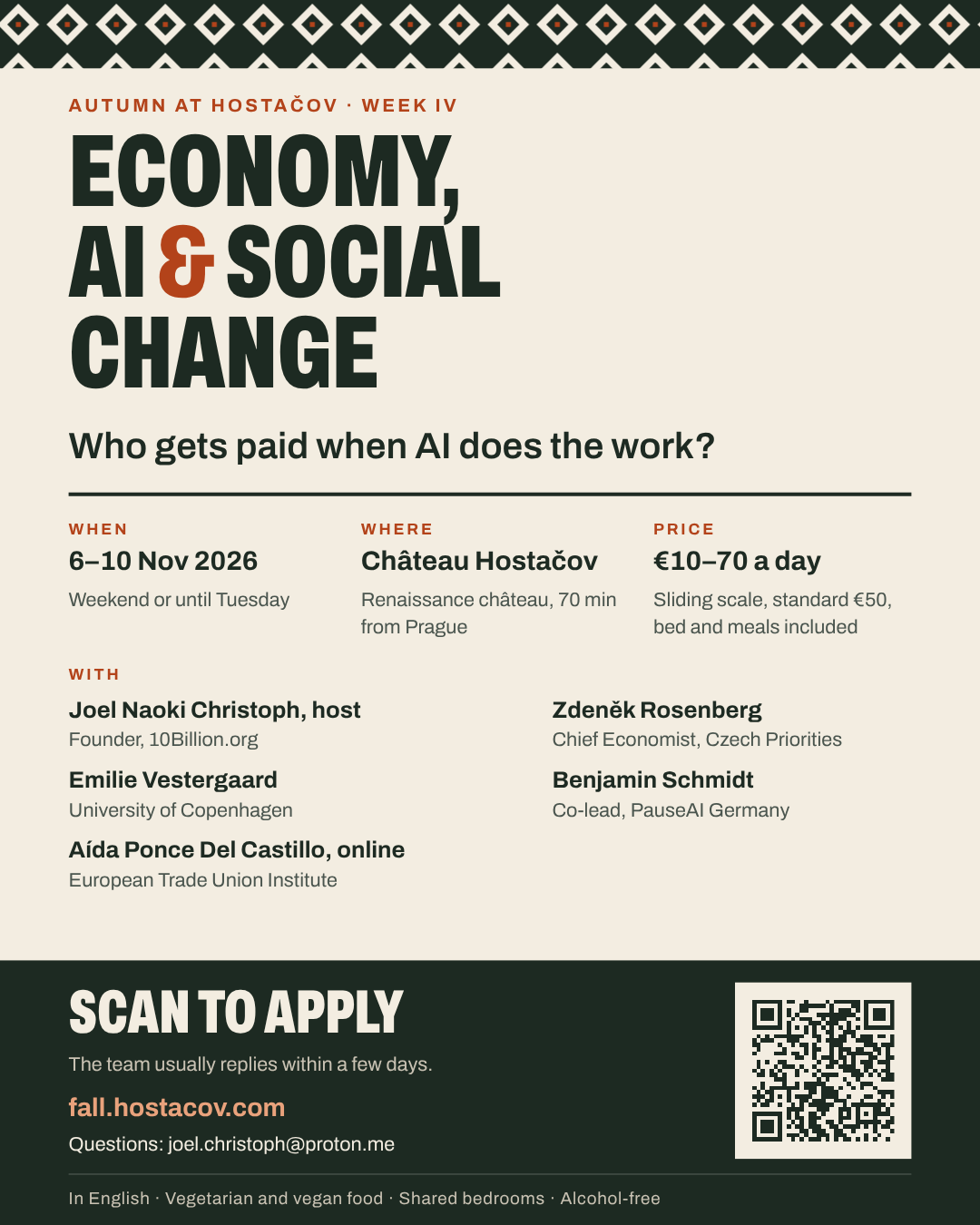
From 6 to 10 November, I'm leading Economy, AI & Social Change at Hostačov, a château just over an hour from Prague. The question: who gets paid when AI does the work? Speakers include Zdeněk Rosenberg (Czech Priorities), Emilie Vestergaard (University of Copenhagen) and Benjamin Schmidt (PauseAI Germany), and participants propose the other sessions. It runs in English, with bed and meals included at €10–70 a day on a sliding scale. If you know someone who might like to come, please pass it on. Details: https://fall.hostacov.com/ Sign-up: https://forms.gle/QRT73PN4HZ5C6KZY9
William Wong
Last Tuesday, a small group gathered in the Committee Room at Newspeak House for PaperJam, our game jam that runs like a book club. This time we played Don’t Look Up, where you’re a billionaire getting richer and taller while keeping everyone’s eyes fixed downward so they never notice what’s above.
We started by sharing our experiences of the game and how it mocks the way the ultra-wealthy keep people distracted from the truth while their fortunes keep growing. We all found the concept and core mechanics compelling, but we agreed something was missing: it’s hard to see how each action, or each choice not to act, leads to a particular consequence.
So when we recreated it as a board game, I added a deck of event cards. Drawing them each round made the crowd’s behaviour much easier to read. We could watch people drift in and out, turn against the authorities or the billionaire, and then get pulled back into distraction again. The satire suddenly had a rhythm we could see, and argue about, at the table.
Thanks to everyone who came and played!
Tess
My contribution for this week’s Dispatches is a thread of thoughts/fieldnotes inspired by books, music, exhibitions/shows, and an event I hosted on AI insurance - common thread = hands.
I’ve always been obsessed with hands. My Nana always said hands are the physical embodiment of the soul. Our eyes might reveal what we feel, but our hands make real what we think, dream, and intend. So hands will be part of my project this year, starting with Craftland, James Fox’s book on Britain’s disappearing crafts, and pulling inspiration from intergenerational skill sharing/the two short films I made about my Nana this summer as she taught me the harp and the bodhrán. Skill travels hand to hand, across generations, by sitting beside someone until it’s in your own fingers.
Hands were everywhere after that. At Café 1001’s bring your own vinyl night (every other Wednesday, a short walk from Newspeak House), a room of strangers built one shared playlist. I really like BYO-anything nights, they work like a mini unconference. They’re low-stakes and spontaneous, the sound isn’t limited to one person’s taste, and because everyone contributed, everyone wants to come back and build on it. Then I watched friends VJing live at Goldsmiths’ Manifold weekend, with visuals made in real time by hand, alongside the music.
On Friday I hosted techUK’s AI insurance in practice half-day session: a keynote, a panel and a hands-on workshop, building on a year of work with Lukasz Szpruch at the Alan Turing Institute. There was good tension on the panel with Martim Cruz (Testudo), Leanne Allen (KPMG), Sandra Blaga (Swift) and Timo Pocock (Advai). What I love about this area is the feedback loop. Good AI assurance lowers premiums, and insurers’ requirements push organisations to build better assurance. Safety stops being a compliance box and becomes an economic advantage. Next up is a paper and a roundtable with the DRCF regulators and government.
In reflection, it sent me back to history. Insurance has often grown out of catastrophe. Ie. After the Great Fire of 1666 destroyed around 13,000 houses, charity alone couldn’t rebuild a commercial city. Organised fire cover followed, including the Hand-in-Hand office in 1696, a mutual where members carried each other’s losses. Lloyd’s coffee house pooled shipping risk, and early railway crashes produced passenger accident insurance. Bismarck’s Germany made social insurance compulsory, and both the Titanic and 9/11 forced insurers to rethink what risk even means. AI as the next chapter? Especially as it moves into critical national infrastructure.
Meanwhile, I finally developed a roll of film on my Canon A1. That’s 36 Portra portraits taken over eight months, each one paused over. I love the delay: the friction, the delayed gratification, the little happy bomb and reconnects that go off months later when you share them with friends.
And to finish, Es Devlin: Other Worlds at the Design Museum (highly rec!). Three takeaways:
- “Every audience is a temporary society.” You sit in the dark with strangers, imagine a world together, then the lights come up and that society dissolves. It’s both transient and transcendent.
- Process as performance. Now that AI can generate content with a click, process matters more than ever and has aesthetic value of its own. Mirrors, cubes and (yes) hands return across her archive, so you watch an artist become herself over decades. She had a bunch of her sketchbooks and showcased the 50 year archive of her process.
- No one makes anything alone. One name is on the title, but work at the scale Es does needs a huge team, and the show barely mentioned them. Compare the Tarek Atoui opening I went to last week spending eight-plus minutes thanking his collaborators at the opening of Hold. The lone-genius myth hides the ecosystem behind it, including the partners, historically often wives and mothers, who carried the load. Ie. when Perelman turned down the Millennium Prize, partly because he felt Richard Hamilton deserved equal credit, he was refusing exactly that myth and was not met with a “YES”.
Which is maybe the whole week in one line: craft, music, art and risk are all things we only ever carry hand in hand.
Clara
A week of inspiration and creation
This year’s chill has well and truly made itself known this week, particularly with Storms Austen and Boelo moving through over the weekend.
On Monday, I attended Faculty member Sarah Meiklejohn’s workshop on ‘Answering unanswerable questions’ alongside a Fellow from the previous cohort. It was a fascinating conversation that prompted reflections on how we use large language models and what it means to know. Later, at Campaign Lab Hack Night, I began prototyping a tool that analyses election leaflets and suggests improvements.
On Tuesday, a group of us tried adapting (/riffing on) a short browser game, Don’t Look Up, into a tabletop game at PaperJam Game Jam. We created and playtested mechanics such as event cards and dice rolls. I drew on my fieldwork (i.e. sampling >30 tabletop games in the past year) to contribute ideas on how a video game could be playable, and even fun, as an analogue game.
I like engaging with a work through different modalities (e.g. analogue and digital). When I asked Claude to build a bot that could play the original game, the bot won in ~7 minutes of game time. Upon further prodding, a faster version won in 6 minutes and 19 seconds.
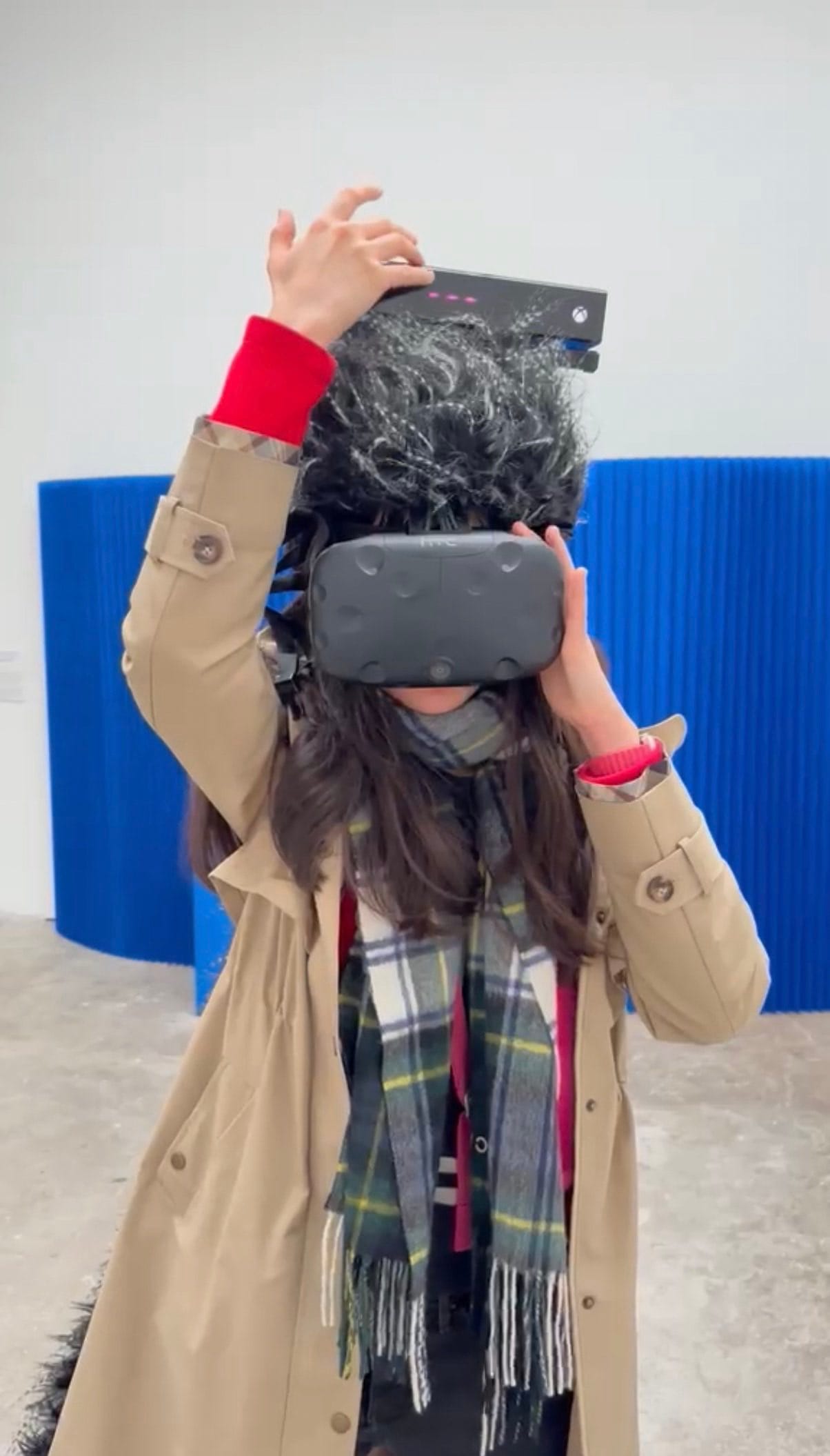
On Friday evening and Saturday, I was in Peckham for the Festival of Creative Computing, where I saw a play (Untitled (Robot Story)), attended three very different talks, and experienced wonderful examples of creative computing. Especially memorable was a contraption which included an Xbox motion sensor, a helmet, and an HTC Vive virtual reality headset. For short intervals, I experienced what it is like to sense through echolocation. A tentacle-like piece driven by six servos also held my attention through its uncanny blend of seeming both organic and mechanical.
Perhaps these examples of creative computing were the spark for a mini project I’m developing now: Horse Generator. Click ‘Randomise’ and it shows you a brand new horse, complete with a registered name and a stable name. This started as an idle thought about demonstrating a horse’s four gaits. Now you can choose the horse breed, coat colours, background and environmental conditions.

As I wrap up against the wind, Robin Wall Kimmerer’s soothing narration of her book Braiding Sweetgrass: Indigenous Wisdom, Scientific Knowledge, and the Teachings of Plants has been a salve for the dreary weather. Her memories of wild strawberries, goldenrods and asters make me yearn for warmer climes. Her reflections add to my own about different ways of knowing: in German, to know can either be kennen (to be familiar with) or wissen (to know a fact), and I think we shouldn’t lose sight of either.
Last words
Thanks for tuning in again. This unofficially completes our first editing “round” of Dispatches, and next week you’ll hear from a new editor-and-publisher combo: Anchit and Mario!
Thanks for letting us, Madison and Anchit, kick off Dispatches for this cohort. Don’t forget to RSVP to our State of the House Address & Christmas Party on December 5th.
Until next week,
The Newspeak House 2026-27 Governance Laboratory
Disclaimer: Views expressed in Dispatches are those of the individual contributors. They do not necessarily represent the views of Newspeak House, its faculty, or other fellowship candidates.