
Dispatches •
Dispatches #5: Who holds the switch, and who wires the switchboard?
Hi all,
Happy Thursday. It’s Anchit and Mario bringing you the fifth issue of Dispatches. For the first time we picked one theme to run through the whole issue: where power lies when we govern with people, with machines, and with both at once.
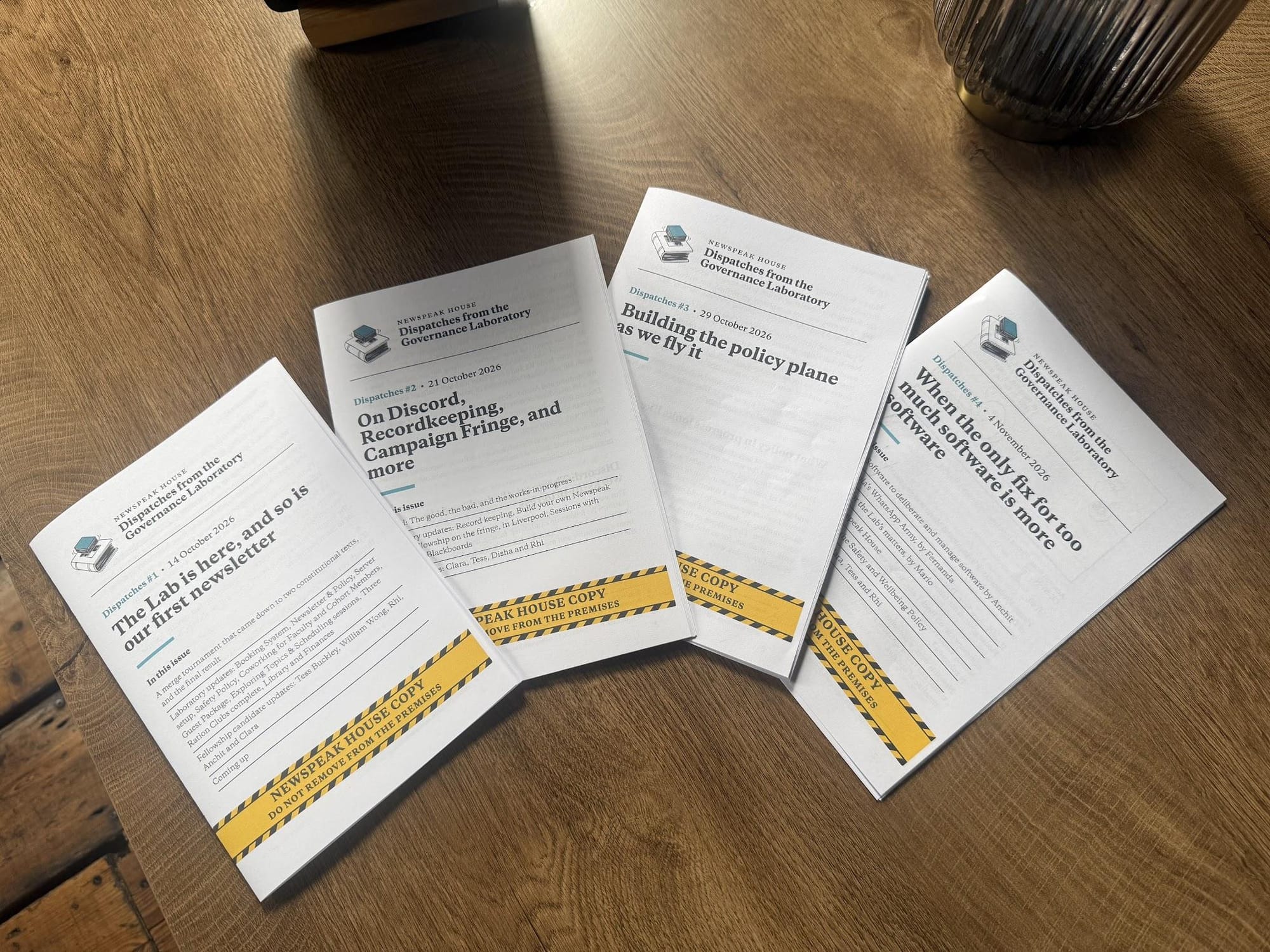
And for anyone who misses that sweet smell of paper: we are now printing Dispatches. Booklets of Issues 1 to 4 are in the Lounge, available only at Newspeak House.
If you’re new here, Dispatches comes every week from our Newspeak House governance laboratory: a group of 14 fellowship candidates exploring and experimenting with political technology, based out of our commons just off Brick Lane. You’re welcome to come visit us for our weekly Ration Club dinner on Wednesday nights, and tell your friends to subscribe.
In this issue
- Editorial: Where power lies in human and AI governance by Anchit
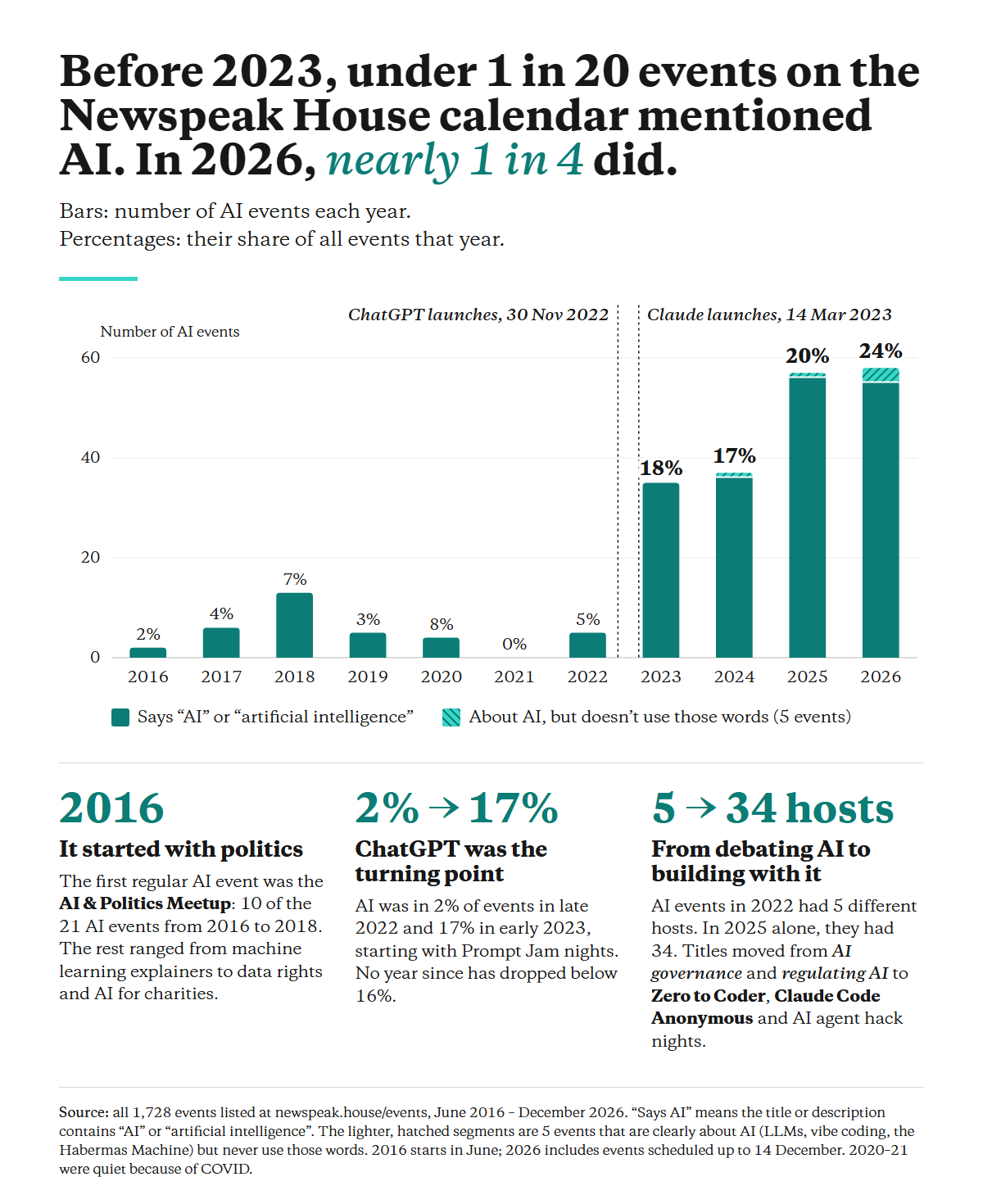
- How often we talk about AI, a dataviz by Clara
- Open-Weight AI Needs Public Rules on Compute, by Joel
- Hello from EL-GPU, by Nick Botti (2025/26 Fellow)
- Laboratory updates: the 6 November cohort meeting
- Overheard at Newspeak House
- Fellow updates: Clara
Where power lies in human and AI governance
By Anchit
So how much talk of AI is too much talk of AI? Clara (Candidate) has been counting. Her dataviz shows conversations about AI at Newspeak House climbing in a straight line, from one in twenty to one in four. It is no surprise, then, that this issue is also about AI, as is most of the world, the stock market and just about every tech bro you can overhear. But in true Newspeak fashion, this issue is not just about AI. It is about the humans using it, how they govern it and who controls it. In other words, it is about where power lies. We are not asking which model tops the trust-me-bro benchmark of this arms race. We ask who holds the switch, and who wires the switchboard?
In our feature article, Joel (Candidate) takes on open-weight models, the hottest f*** you to the closed models of American Big Tech. Once an open-weight model's weights are released, nobody holds the switch: there is no recall and no patch. That is exactly what makes these models useful to a campaign group a supplier might rather shut out, and exactly what makes them hard to govern. So Joel wants the public to step in earlier, upstream, while a model is still being built. Training the largest models takes thousands of chips, vast data centres and the electricity to run them, and unlike a file of weights, chips can be counted and buildings visited. His proposal: check developers' claims against data-centre records, test models before release, and give UK support for new data centres only in return for safety checks and computing time for public projects.
Nick (fellow 25/26), writing from EL-GPU, takes the next step: if the problem is who controls the hardware, why not own it ourselves? But the peril is still governance, because someone still has to write the rules. A community co-op has to decide who gets access, what gets refused and who hears the appeals. Which points to something that runs through this whole issue: whether we are governing machines or people, we are almost always governing people.
Which brings us home to the Lab. Our Laboratory update on the 6 November cohort meeting is the human half of the story. Our interim constitution expires on 30 November, and the process to renew it has yet to start. We built a layered set of rules, and Yiannis (Candidate) built an AI agent to make them easier to use. The agent works, and almost nobody uses it. Members disagree about why, but none of their explanations is about the machine. They are about how humans interface with technology, regardless of its ability to talk back or pass the Turing test.
There is one thing AI cannot do, open-weight or not: come to Ration Club. Only you can, so come through on Wednesday at 7pm, and watch our short video inviting you to the State of the House Address and Christmas Party on 5 December. And while your agent could read this newsletter and produce a passable critique of it, we would much rather hear from your own 7,500-trillion-parameter prefrontal cortex. So please subscribe and let us know what you thought at newspeakhouse26@gmail.com.
How often we talk about AI
A dataviz by Clara
Open-Weight AI Needs Public Rules on Compute
By Joel
I want a campaign group to keep using its AI tools even if the supplier dislikes its politics. Open-weight models make that possible. Their developers publish the weights, the numbers a model learns during training, so anyone with suitable hardware can download, run and adapt a copy. Once copies spread, the developer cannot recall or patch them.
Building such a model takes far more than running it. The best public figures I know come from Meta, which published both. In July 2024, it reported training Llama 3.1 405B on more than 16,000 Nvidia chips. It also said a compressed version could run on a single server. The largest open models released since then are bigger still. So a co-op can run a copy of such a model on one machine. It cannot decide which models anyone builds. Only a few firms can pay for the compute behind them: thousands of chips, the data centres housing them and the electricity they draw.
This issue asks who decides what is safe once no one can switch a model off. I think the public should decide earlier, while the developer can still change course. Under the AI Act, the EU presumes that a model trained with more than 10²⁵ calculations (a 1 followed by 25 zeros) poses systemic risk. Its developer must notify the European Commission within two weeks of learning that the model will cross that line, even if training is still underway. Publishing the weights does not exempt a developer from the extra duties.
Regulators should go further. They should compare developers’ reports with records from the data centres that trained the largest models. Inspectors can count chips and visit buildings in ways they never can with a file of weights. Before release, independent testers should check what those models can do once someone strips out their safeguards.
In the UK, the government’s AI Growth Zones guidance offers help with planning and power for large data-centre sites proposed by councils or developers. I want that help to come with conditions: those safety checks, a share of computing time for civic or research projects and a public record of what each developer received.
The firms that run these data centres could use safety checks to shut out competitors, including smaller labs in the Global South. I would apply the checks only to the largest training runs. Operators should publish their access rules, give reasons for every refusal and let applicants appeal to someone independent. Governments should also fund affordable computing under public or cooperative control.
To start, ask your council whether it has applied for a Growth Zone or backed a data-centre project. Ask it to publish what it offered the developer and what the public receives in return. If you run a shared computing service, like the East London GPU Co-op, write an access policy that members can amend. Give members a way to appeal when an operator refuses access on safety grounds.
To help write compute rules, join the free eight-week course I run at computefellows.org.
Hello from EL-GPU
By Nick Botti (2025/26 Fellow)
Hello from EL-GPU! We’re a group trying to start a community-run GPU co-op in East London: shared hardware, open-source models, run by the people who use it instead of shareholders. We’re off to an exciting start with some hardware, models, and members. But plenty of open questions still to work out.
Interested in learning more? Check out our meetup/hack night this Thursday 12 November at Newspeak House: lu.ma/lofas446
Laboratory updates
Cohort meeting, 6 November
The fellowship candidates meet every few weeks to run the business of the Lab under the constitution we wrote together six weeks ago. Seven of us met on 6 November, with Noam (Candidate) in the chair. Fewer than half the cohort attended, so the meeting could not make policy; what follows is a flavour of the discussion.
A constitution with an expiry date
Our constitution is an interim one. It expires on 30 November, and a renewal process has to be under way by 23 November. The meeting favoured running it online through docs.vote, with meetings alongside to help people catch up, and Noam will convene it.
Rules that outrun their users
The longest discussion was about participation. Our rules come in layers, from quick rules that pass unless someone objects to full policies that need a vote. Yiannis (Candidate) has built an AI agent that lets members draft policy without editing the record by hand, but so far almost nobody has used it, or the policy process itself.
Three readings of the problem
Members disagreed about why. Madison (Candidate) and Clara felt the process was too complicated and that important messages get lost on a busy Discord; Yiannis(Candidate) pointed to the policies that have already passed; Ed (Dean) noted that every government faces the same problem. The question now goes to the constitutional review.
What was agreed
Ration Club, the House's Wednesday community dinner, stays open and free. December hall dates will go first come, first served on Discord, and Noam will circulate a fuller write-up.
Overheard at Newspeak House
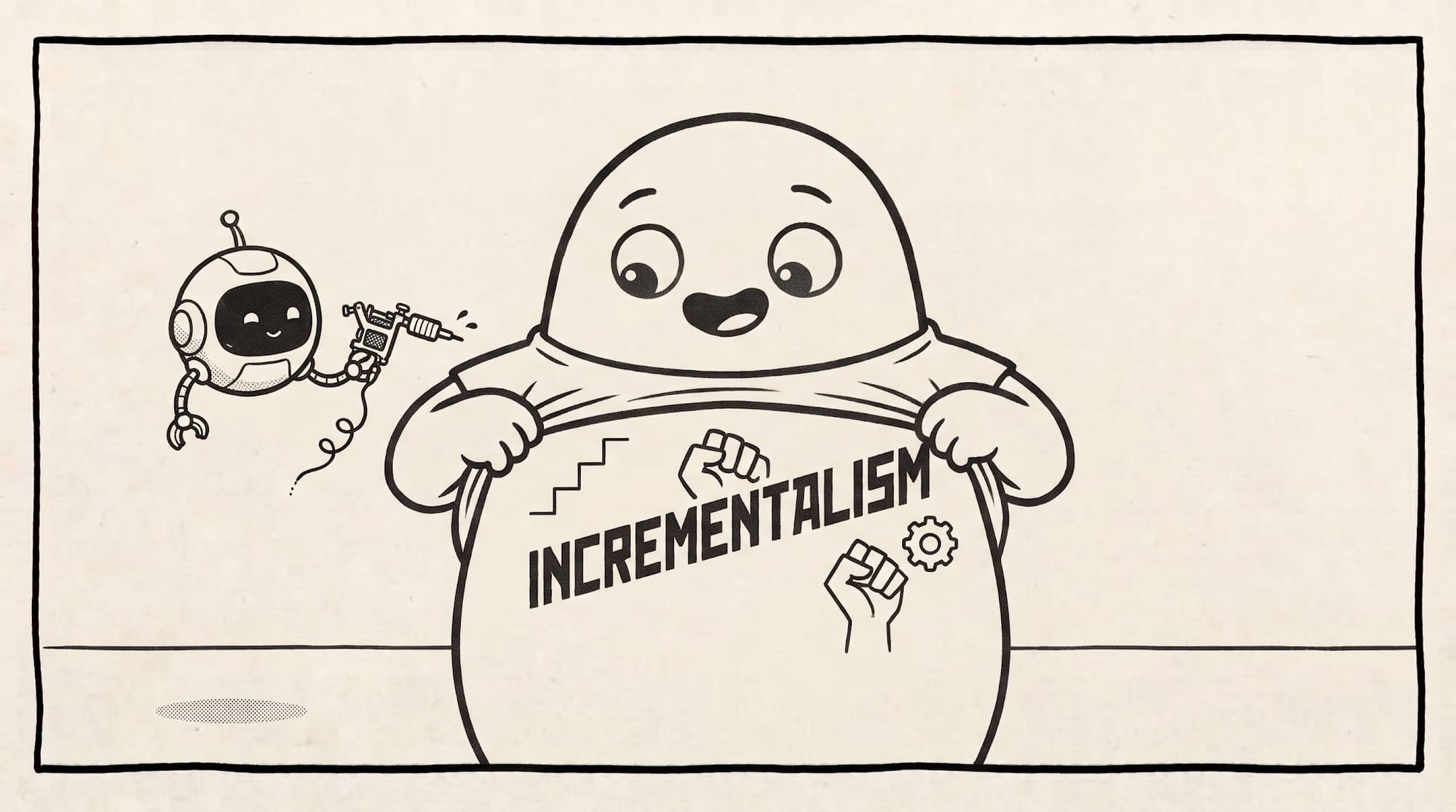
“Show me your chest tattoo of the word ‘incrementalism’.”
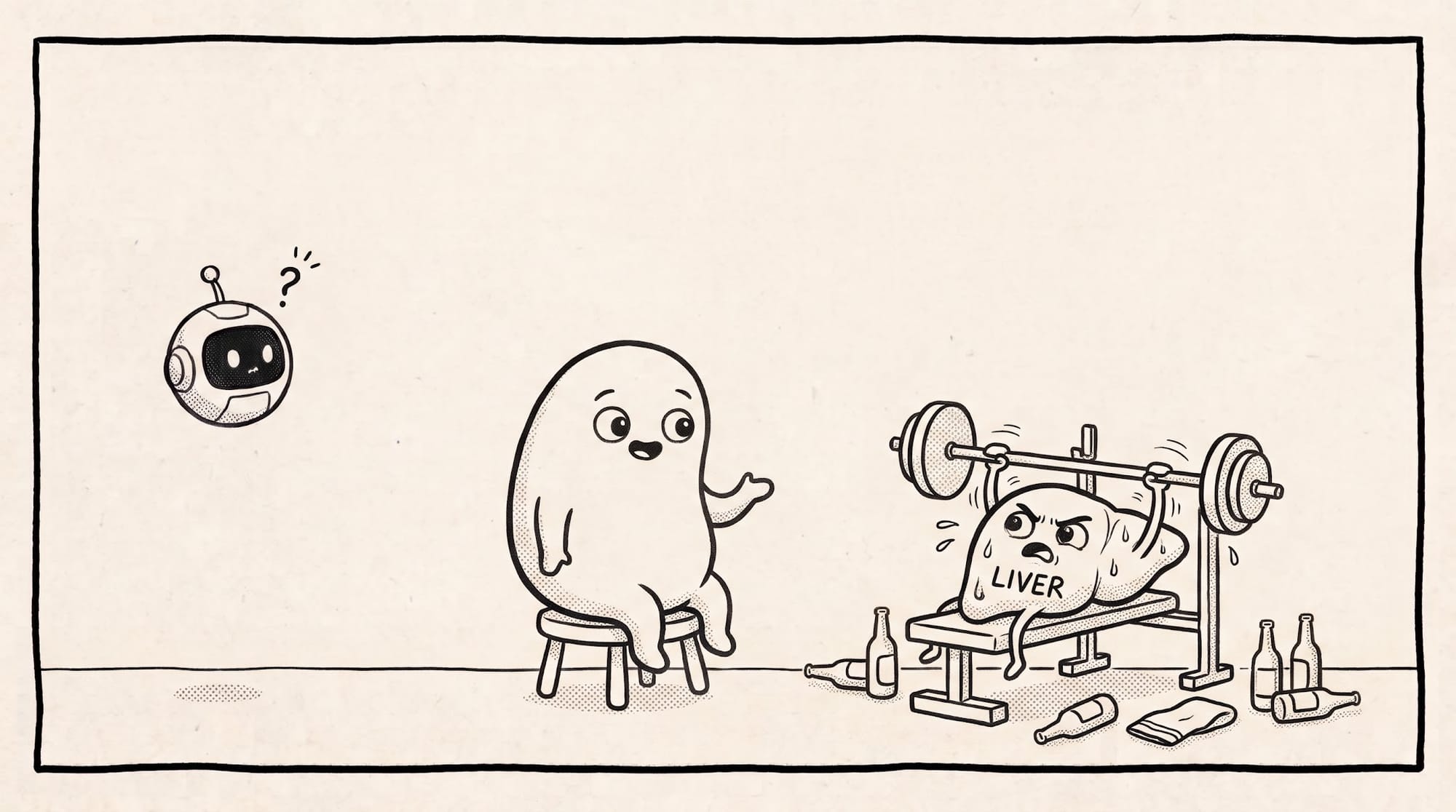
“If you’re not exercising your liver, how is it going to get stronger?”
“In a way isn’t memory a kind of recording?”
“We like our human [Dispatches] editor.” (discussing a potential cohort-wide AI agent)
Fellow updates
Each fellow keeps a running timeline of their updates. Here’s a taste of this week’s; follow the link for the full version.
Clara
This week I’ve been building by two principles: minimum viable product, and “joy is an act of resistance”. That means inviting you to try my web app Branchwise, a few detours instead of launching its sister app Countermap, and an 8-bit horse eating grass.
Last words
Thanks for reading. Ration Club is every Wednesday. Don’t forget to RSVP to our State of the House Address & Christmas Party on 5 December.
Until next week,
The Newspeak House 2026-27 Governance Laboratory
Disclaimer: Views expressed in Dispatches are those of the individual contributors. They do not necessarily represent the views of Newspeak House, its faculty, or other fellowship candidates.
Disclaimer: Views expressed in Dispatches are those of the individual contributors. They do not necessarily represent the views of Newspeak House, its faculty, or other fellowship candidates.