
Dispatches •
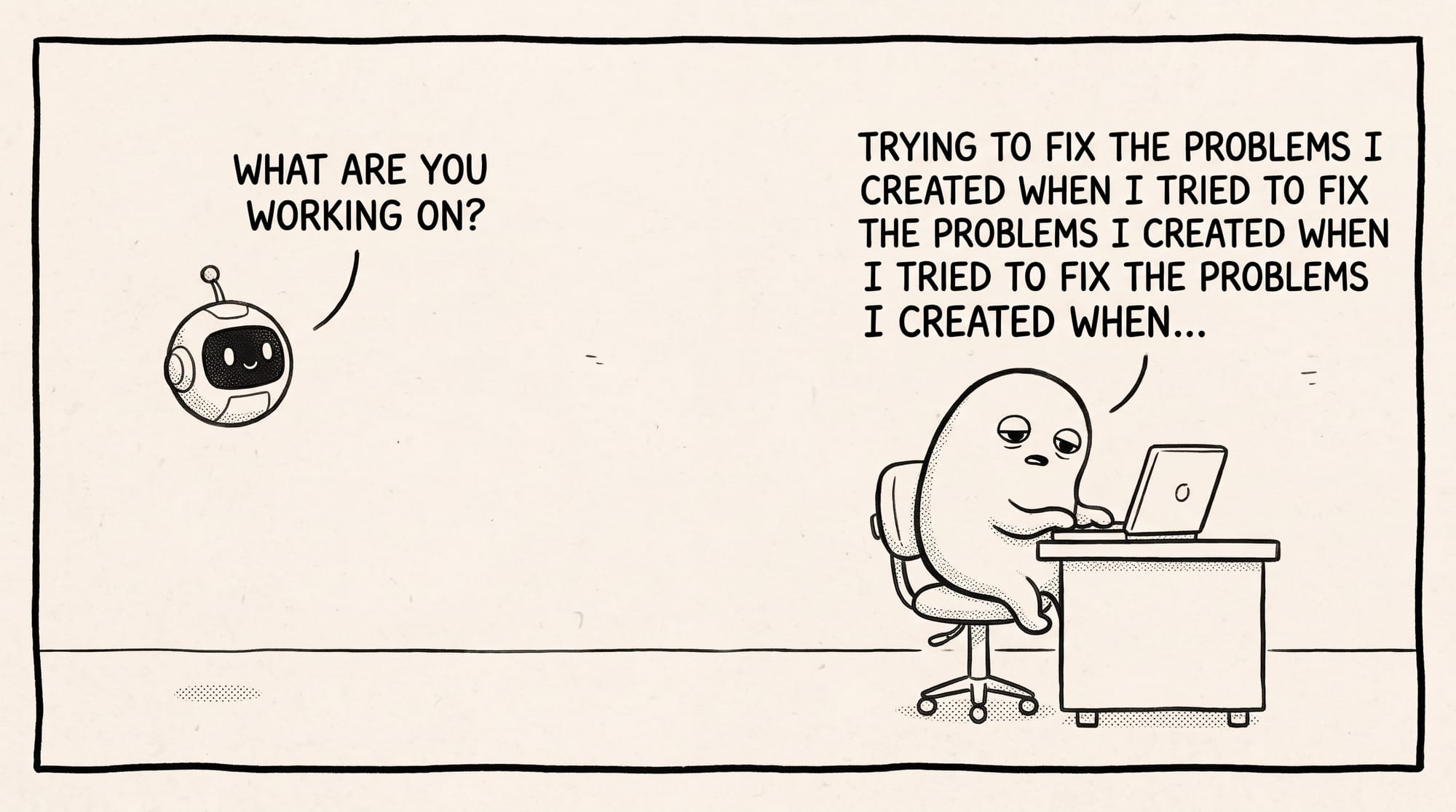
Dispatches #4: When the only fix for too much software is more software
Hi all,
Happy Wednesday. It’s Anchit and Mario bringing you the fourth issue of Dispatches, this week on digital deliberation: what happens when the tools we use to decide things start to need tools of their own.
If you’re new here, Dispatches comes every week from our Newspeak House governance laboratory: a group of 14 fellowship candidates exploring and experimenting with political technology, based out of our commons just off Brick Lane. You’re welcome to come visit us for our weekly Ration Club dinner on Wednesday nights, and tell your friends to subscribe.
New this week: a contents list below, overheard at newspeak house comic and fellow updates as short teasers that link to each fellow’s own timeline of updates.
In this issue
- Editorial: Software to deliberate and manage software by Anchit
- Brazil and Lula’s WhatsApp Army, by Fernanda
- A new tracker for the Lab’s matters, by Mario
- Overheard at Newspeak House
- Laboratory updates: the Safety and Wellbeing Policy
- Fellow updates: Joel, Clara, Tess and Rhi
Software to deliberate and manage software
By Anchit
In 2011 there was a prediction by Marc Andreesen (a2z VC) that software was going to eat the world. By and large, if you look at market capitalisation, there does seem to be some ring to it. But there are new entrants among the giants shaking it up, while we love to hate them, we just can’t stop vibe coding. Either way, software has been around for more than a few decades now, and one of the fun things we have realised is that there is a lot of it. It can allow you to do great things, and the one we are chasing this week is digital deliberation.
Our newsletter starts with something historic that software helped achieve, though it is more mobilisation than deliberation: a fourth win for Lula and, as Fernanda tells it, the first time a Brazilian candidate has lost the first round and won the second. Part of that ran on one WhatsApp channel with nearly 11 million followers, doing simple daily missions. The fun thing is that we are 14 people in a cohort with 7 apps. Where the first ratio was 11 million people to one channel, ours is two people per tool. This is what Mario's piece talks about: when software starts multiplying and taking on use cases, what do we do to make all of it manageable? Spoiler: we make more software. That isn't always bad, and we're not against a multiplicity of software; new political technology is in our mission. Then again, one channel did just reach 11 million people, so what if your politics is monopolistic, or high modernist, with the faith that one rational design, drawn up at the centre, can define how everyone lives?
Regardless of your politics, Clara's fellow update touches on what designing for choice looks like, instead of one tool to rule them all, she has built a unique faculty session booking workflow where one form sets off updates on 5 separate applications. Such that, wherever people are in this busy digital world, they can receive updates that matter.
But many tools or one, software is only as good as the codified rules it is designed to emulate, or the unwritten social contracts that come to be facilitated by it. This is where the lab update on our Safety and Wellbeing Policy comes in: it helps create the norms for deliberation and the spaces for decision-making.
This newsletter happens every week and is delivered to your email inbox once you subscribe. If you have brickbats and bouquets, please send them on here newspeakhouse26@gmail.com.
Brazil and Lula’s WhatsApp Army
By Fernanda

As a Brazilian immigrant, on 25 October I made my way to the polling station in London. Unlike in 2022, I didn’t stay up for the results. I thought the fate was sealed and went to bed.
I woke up to find Brazil had done something it had never done before. No candidate had ever lost the first round and gone on to win the second. Lula did.
Over 10 million more people voted for Lula in the second round than in the first. Plenty of things contributed to that, and people will be untangling them for years, but the WhatsApp Army is one that has really piqued my interest.
The WhatsApp Army
“We’re going to build very strong digital communication. I’ve already been given a phone. Now, get ready! I’m no longer going to talk to you through the press’s interpretation. I’m going to talk to you through Janones’s channel.”
Lula had long resisted being online, but on election night, this is what he told the crowd.
In Brazil, WhatsApp is used for everything: getting news, running a business, speaking to your doctor, sending your therapist 15-minute voice notes. So it makes sense the campaign used the channel of the people.
After the first round, a WhatsApp channel run by congressman André Janones, Exército do Lula (Lula’s Army), had around 60,000 followers. By election night it had nearly 11 million. This was a broadcast (one-way) channel: every day they got “missions”: recruit three friends, share this video, push this hashtag.
Three questions for the Lab and the House:
Civic tech channels: what happens when the people’s channel belongs to Meta?
Keeping people engaged: can a one-way channel hold a crowd once the election is won?
From mobilisation to governance: how does a following learn to push back?
Laboratory updates
A new tracker for the Lab’s matters
By Mario
How do we keep track of the experiments we are running? This is one of the questions outlined in the guide we were given. We have our Dispatches to share our updates, a public repo to record our decisions, but until now, no one place to track all our various deliberation processes and governance experiments through time. We now have a space that may be able to help with that. You can view it here.
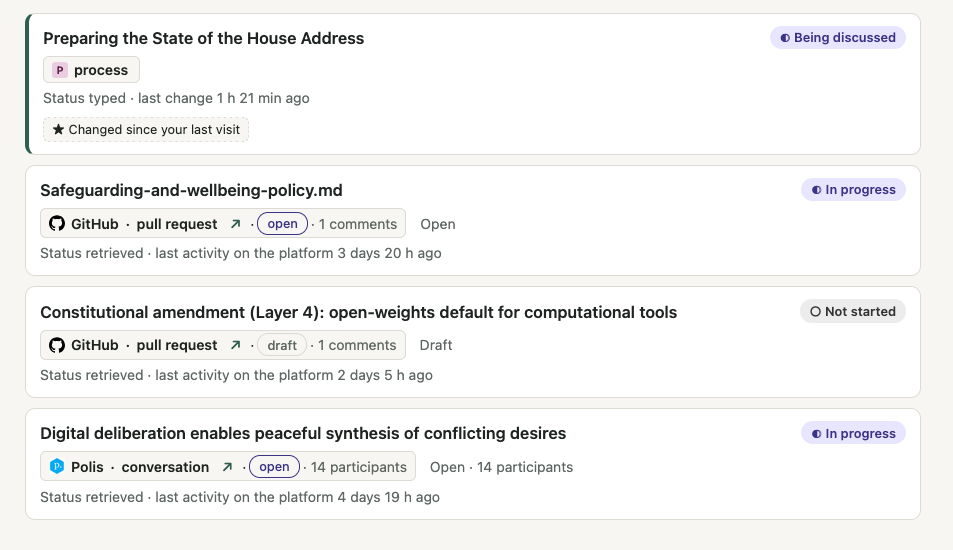
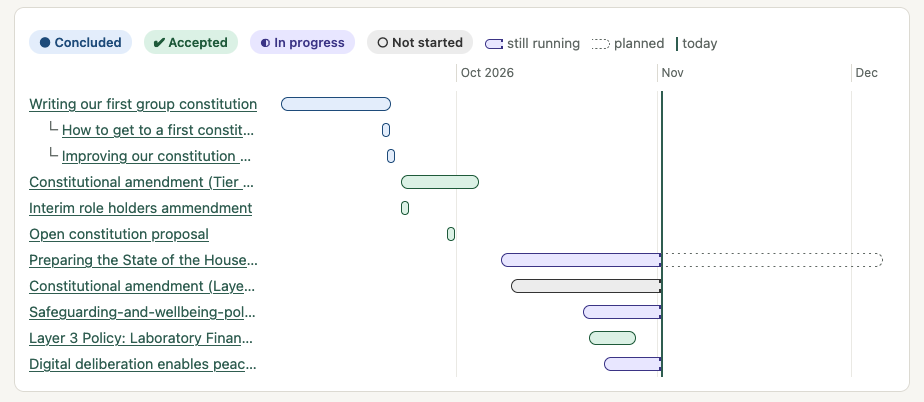
The main idea is simple: link each matter to wherever it is being worked on. It supports a few built-in tools (Polis, GitLab, OpaVote…), but it’s also very easy to add new tools. Pasting a URL to an item (issue, conversation…) from one of these connected tools will retrieve its metadata for easy ingestion into our space. The hope is that it doesn’t just result in another isolated tool, but that by bridging with other ones, it encourages experimenting with existing or new technologies.
Of course there are plenty of open questions about this system: What processes do we include, which ones do we not? How do we know when they finish? Can it also foster the use of non-digital methods? What categories, semantics and relations do we use to represent the variety of our processes? Who will curate entries? Given a new collective question, need or objective, could this be a good place to help us decide what tool to use?
Whether or not it brings any substantive value to our laboratory experiments, expect to hear more about it in the future. And feel welcome to play with the prototype and send any feedback.
Safety and Wellbeing Policy
Growing and learning depend on feeling safe. When adrenaline is coursing through our bodies, it's hard to sleep or think clearly, let alone create something innovative. For many in this year's Newspeak House fellowship cohort, the House is a home as well as a place to work, learn and argue. During our kick off weekend we were all very clear on the importance of a safety and well being policy because we believe that a community built on open disagreement needs to be just as clear about care. As some of you readers might already know, we govern ourselves under a constitution we wrote together, which raises the question: if someone feels unsafe, who do they turn to, and what happens next? Outlining this in a Safety & Wellbeing Policy is the start.
A small group of fellows drafted the first version. It has since been revised and checked against our Constitution, so the policy works within it. We also spoke with the Dean of Newspeak House so that our process fits with the existing House's Exclusion Policy, giving people one clear path for when incidents occur.
The policy opens with a quick-reference contact list and a "find what you need" guide, followed by steps for common situations: someone is in danger, someone has confided in you, or you saw something that wasn't right. It gives every member three tools they can use at once without asking permission. They can act to keep someone safe in an emergency. They can call a safety pause on an activity or decision for up to 72 hours. And they can tap out of a conversation that has crossed a boundary.
The policy also sets out what happens after a concern is raised. Any remedy must aim at safety and repair, not punishment. Serious harm, such as harassment, threats, sexual misconduct or anything that may be criminal, will be taken very seriously.
Where are we now?
The revised draft is in its formal seven-day decision process on our constitutional record. Before it is final, we will appoint a Safety Lead and a Deputy (or co-safety leads still being discussed/deliberated), recruit volunteer facilitators and choose the training they will receive. We hope to share the adopted policy soon.
If you have experience building care or safety processes in communities like ours, we'd love to hear from you.
Overheard at Newspeak House
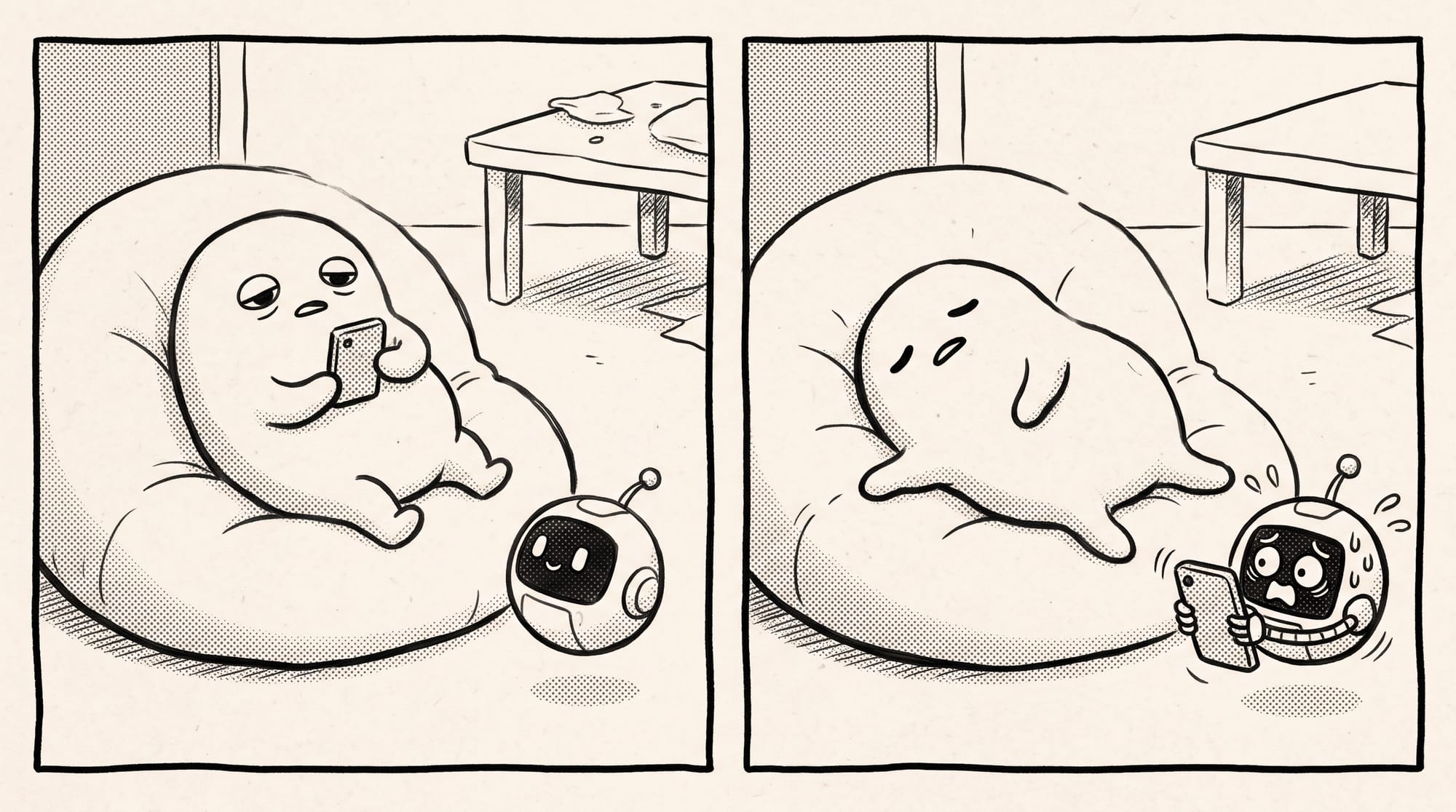
“Doomscrolling is bad, so I’m going to make my agent do it instead.”
“The (robot) dog will carry the leaflets.”
"Grok is trained on pornography, that’s the context you need for this."
Fellow updates
Each fellow now keeps a running timeline of their updates. Here’s a taste of this week’s; follow the links for the full versions.
Joel
I entered the Existential Hope Meme Prize with a dad in a solar-powered 2050 asking his daughter, “Do you think energy just falls from the sky?” And the Economy, AI & Social Change weekend I’m leading at Hostačov Castle runs from 6 to 10 November.
Clara
On Wednesday 28 October, Faculty members began using the new session booking system that I developed. We now have 9 Faculty sessions scheduled and more in the pipeline. Also this week: deliberation about deliberation, a solarpunk game jam idea, and a counter-surveillance LARP.
Tess
The biggest win of the week: I’ve finally landed on a name for a project that’s been in the works and piloting for about three years. It’s called Creatives for Reimagining Futures.
Rhi
At last week’s Ration Club I had a great conversation with Hannah about what the next move could, would or should be for my work tracking decisions around the freeze on trans surgery in Wales.
Last words
Thanks for reading. Ration Club is on tonight, as it is every Wednesday. Don’t forget to RSVP to our State of the House Address & Christmas Party on 5 December.
Until next week,
The Newspeak House 2026-27 Governance Laboratory
Disclaimer: Views expressed in Dispatches are those of the individual contributors. They do not necessarily represent the views of Newspeak House, its faculty, or other fellowship candidates.
Note about Dispatch #2: A sentence was edited to specify that John simply tried to inform us about Matrix (the decentralised communication network), without intention to convince us. How sweet!
Disclaimer: Views expressed in Dispatches are those of the individual contributors. They do not necessarily represent the views of Newspeak House, its faculty, or other fellowship candidates.