
Tess’s updates
Tess’s updates from Dispatches, the newsletter of the Newspeak House 2026/27 fellowship candidates. Newest first.
Dispatches #4
4 November 2026 · from Dispatches #4: Software to solve the software
The biggest win of the week: I’ve finally landed on a name for a project that’s been in the works/piloting for about three years, and I used ‘Claudette’ to draft a website for it. It’s called Creatives for Reimagining Futures. Picture “Creatives” as a Solari board cycling through disciplines (musician, photographer, dancer, writer…), and “Futures” as another Solari board cycling through things to reimagine (planetary futures, cities, AI and tech…). This year I want to really lean into this project/practice and formalise it to further centre the role of the artist in organising and empowering against centralised power, and in offering alternatives to panic and/or paralysis.
Monday saw the launch of BridgeAI 2.0, a partnership between Innovate UK, Digital Catapult, the National Physical Laboratory and the Alan Turing Institute. A few thoughts: I’m still not convinced we do enough outside London, tbh! There’s also the scaling problem: pilots don’t get the funds to grow in the UK, so they hit a cliff edge and/or head to the USA (this also came up in the Investors for CreaTech event I ran a few weeks back). And many applicants struggle to find an SME or industry partner to bid with, someone who’ll give them the real-world place to test their idea that they need in submissions. So in 2027 I’m aiming to run a reverse-pitching style event, where SMEs and industry pitch their pain points and openness to collaboration to academics. The companies will commit to picking someone from the audience to move forward with at the close. I’ve run reverse pitching with investors before, and it’s nice to change who’s talking at whom.
On Tuesday I loved the cohort reunions at Newspeak House that came with faculty member Theo’s lecture, and I’m so grateful for our beautiful new booking system that will lead to more evenings of learning!
Wednesday got me rethinking how odd it is that we’re so fixated on putting others, and ourselves, into groups. I spent most of Ration Club talking (as ever), watching people add to the new weekly conversation canvas, and trying a new format for the ‘interactive’ chalkboards in the lounge. Honestly, the Venns and x/y graphs to date are mostly a joke and an excuse for a conversation. The fun is hearing people justify where things go, and then argue about why the whole frame doesn’t make sense. Some faculty pointed out that membership is the wrong lens for mapping these communities on the Venn diagram chalkboard, and that engagement with shared infrastructure describes them better. Point taken! So I made a more serious board and put my data hat back on: if you want to know how people are part of a group, look at the social infrastructure they use and how often they engage with it.
Labels help us make sense of things, but they always oversimplify, and the boundaries between these communities aren’t clean. If you have ideas for other formats to try, the odder the better, we’d love to hear them. On the theme of labels, a conversation with a friend this week led to this quiz on the fundamental questions in today’s AI debate. You can reflect on where you stand, and maybe come away with a label and a fun little polygon. It’s also six years since my EP Percentile, which was a dedication to the immeasurable. A percentile ranks a score within a dataset in a way that feels scientific, objective and final. But we aren’t data points. We’re complex, contradictory and always changing, and life happens in the in-betweens. The EP was, and still is, a rejection of those limits, even though I’m still out here drawing Venn diagrams.
Moving on to Thursday thoughts… one of the biggest differences I noticed moving from Canada to London was class. In Canada, class mostly comes down to what you earn. In the UK it is different: as a British friend tried to explain, you can be ‘rich’ and still “low class”, or broke and “unmistakably posh.” Class is treated here as something that follows you through your accent, your school and your tastes, whatever happens to your income, which is odd and shouldn’t be the case (yes, duh, T!). Being Canadian puts me a bit outside the system, which makes it easier to see and harder to understand. Brits can often place someone’s background within a few sentences based on accents. Five years in, I can only reliably spot Liverpool and Scotland! It connects to my 2020 MA in Philosophy and AI, where I specialised in ableism in biotech. During the 2017/18 wave of work on AI bias, most of the attention went to sex and race, which mattered and still does. Class and disability got far less (and still do!), partly because they’re harder to measure. What doesn’t get measured doesn’t get studied, and what doesn’t get studied doesn’t get fixed. Who does the research matters too. Cost, precarity and inaccessible environments keep many disabled and working-class people out of postgraduate research, or make it harder to enter, so the people most affected by these biases are often missing from the rooms where the research questions get chosen. So Thursday night felt like a full-circle moment. I was on the terrace of the House of Commons for the first-ever AI and Social Mobility Challenge with the EY Foundation, Social Tech Trust and the Social Mobility Commission. I’d been part of the early scoping, working on the evaluations and the application forms: who applies, what gets measured, and what “success” actually means.
The week ended with a glorious Friday morning coffee with a friend on a barge: M/S Hans, built in 1915 by the Muller yard in Amsterdam as a coastal steamer (if you know me, you know I love boats). She was converted for residential use from 2007 and brought to London in 2009 as a family home and cruising barge. Her owner was a founding member of the Hermitage Moorings Co-op, and our conversation was the kind that opens 1,638,292,729 tabs and feels like the start of a wildly cool multi-fork collaboration.
Finally, random idea of the week: LinkedOut, a place where people share event fails and what they learned, along with salary bands, tips for keeping going, and the real culture of an organisation. A bit like Glassdoor, but a bit wider and more in the spirit of ‘we’re all imperfect and we all mess up, and that’s how we do better next time.’
Dispatches #3
29 October 2026 · from Dispatches #3: Building the policy plane as we fly it
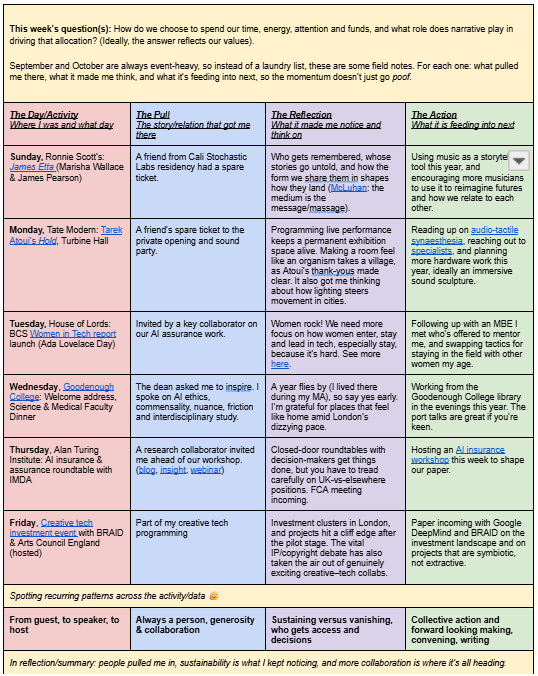
My contribution for this week’s Dispatches is a thread of thoughts/fieldnotes inspired by books, music, exhibitions/shows, and an event I hosted on AI insurance - common thread = hands.
I’ve always been obsessed with hands. My Nana always said hands are the physical embodiment of the soul. Our eyes might reveal what we feel, but our hands make real what we think, dream, and intend. So hands will be part of my project this year, starting with Craftland, James Fox’s book on Britain’s disappearing crafts, and pulling inspiration from intergenerational skill sharing/the two short films I made about my Nana this summer as she taught me the harp and the bodhrán. Skill travels hand to hand, across generations, by sitting beside someone until it’s in your own fingers.
Hands were everywhere after that. At Café 1001’s bring your own vinyl night (every other Wednesday, a short walk from Newspeak House), a room of strangers built one shared playlist. I really like BYO-anything nights, they work like a mini unconference. They’re low-stakes and spontaneous, the sound isn’t limited to one person’s taste, and because everyone contributed, everyone wants to come back and build on it. Then I watched friends VJing live at Goldsmiths’ Manifold weekend, with visuals made in real time by hand, alongside the music.
On Friday I hosted techUK’s AI insurance in practice half-day session: a keynote, a panel and a hands-on workshop, building on a year of work with Lukasz Szpruch at the Alan Turing Institute. There was good tension on the panel with Martim Cruz (Testudo), Leanne Allen (KPMG), Sandra Blaga (Swift) and Timo Pocock (Advai). What I love about this area is the feedback loop. Good AI assurance lowers premiums, and insurers’ requirements push organisations to build better assurance. Safety stops being a compliance box and becomes an economic advantage. Next up is a paper and a roundtable with the DRCF regulators and government.
In reflection, it sent me back to history. Insurance has often grown out of catastrophe. Ie. After the Great Fire of 1666 destroyed around 13,000 houses, charity alone couldn’t rebuild a commercial city. Organised fire cover followed, including the Hand-in-Hand office in 1696, a mutual where members carried each other’s losses. Lloyd’s coffee house pooled shipping risk, and early railway crashes produced passenger accident insurance. Bismarck’s Germany made social insurance compulsory, and both the Titanic and 9/11 forced insurers to rethink what risk even means. AI as the next chapter? Especially as it moves into critical national infrastructure.
Meanwhile, I finally developed a roll of film on my Canon A1. That’s 36 Portra portraits taken over eight months, each one paused over. I love the delay: the friction, the delayed gratification, the little happy bomb and reconnects that go off months later when you share them with friends.
And to finish, Es Devlin: Other Worlds at the Design Museum (highly rec!). Three takeaways:
- “Every audience is a temporary society.” You sit in the dark with strangers, imagine a world together, then the lights come up and that society dissolves. It’s both transient and transcendent.
- Process as performance. Now that AI can generate content with a click, process matters more than ever and has aesthetic value of its own. Mirrors, cubes and (yes) hands return across her archive, so you watch an artist become herself over decades. She had a bunch of her sketchbooks and showcased the 50 year archive of her process.
- No one makes anything alone. One name is on the title, but work at the scale Es does needs a huge team, and the show barely mentioned them. Compare the Tarek Atoui opening I went to last week spending eight-plus minutes thanking his collaborators at the opening of Hold. The lone-genius myth hides the ecosystem behind it, including the partners, historically often wives and mothers, who carried the load. Ie. when Perelman turned down the Millennium Prize, partly because he felt Richard Hamilton deserved equal credit, he was refusing exactly that myth and was not met with a “YES”.
Which is maybe the whole week in one line: craft, music, art and risk are all things we only ever carry hand in hand.
Dispatches #2
21 October 2026 · from Dispatches #2: On Discord, Recordkeeping, Campaign Fringe, and more
Dispatches #1
14 October 2026 · from Dispatches #1: The Lab is here, and so is our first newsletter
I continue to orbit around a few core questions: how do we organise, how do we empower, how do we sustain, and how do we reimagine our futures and relation to each other? (And what role do music, art and stories play in all of it?)
This week’s work is a continued attempt to answer them, treating music as infrastructure for movements amongst other things. I came out of a two-day Deeply Human Summit in Paris with a real action item (lush!): Mingzhu He and I ran the three-session track on public movements and collective action, and from it I’m now developing a site (with friends) to help people working on hopeful futures of care find each other. I’m also writing a piece for Tania Duarte/We&AI on music as protest and its role in past (and potentially future!!) public movements.
This week I’m pushing to record the song I shared to close the two days, a bit of an anthem, set to be produced by Walter Werzowa, who was in the audience, so he offered to help out. In this vein, I’m keen to book my first songwriting session for musicians to imagine the future and AI, ideally in November, most likely on the terrace and/or in the lecture room at Newspeak House.
Alongside that, I’m copy editing Remixter and building a page that visualises its data with ambient song, in conversation with Will Wright’s team, who are interested in the memory side of this.
After a good while in the works, “RAIM: Operationalising Trustworthy AI in Music Generation” is now published in IEEE Transactions on Technology and Society, and I’m thinking through next steps for it and its accompanying website. Finally, I’d love to connect more with faculty this coming week, so aiming to book more sessions. Please do reach out for a coffee, or come co-work at Newspeak House on Monday’s informal working day.